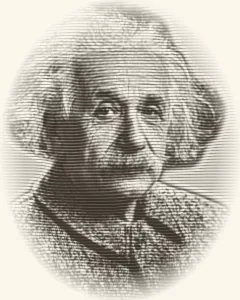
Richard Feynman1918–1988
Physics is like sex: sure, it may give some practical results, but that’s not why we do it.
- The Character of Physical Law (1965), chapter 2, “The Relation of Mathematics to Physics,” p. 58
All theoretical chemistry is really physics; and all theoretical chemists know it.
- Often credited to Evan Spigelman
- The Meaning of It All (1999), lecture II: “The Uncertainty of Values”
The first principle is that you must not fool yourself—and you are the easiest person to fool.
“Cargo Cult Science”, adapted from a 1974 Caltech commencement addressI think I can safely say that nobody understands quantum mechanics.
The Character of Physical Law (1965), chapter 6, “Probability and Uncertainty — the Quantum Mechanical View of Nature,” p. 129A very great deal more truth can become known than can be proven.
“The Development of the Space-Time View of Quantum Electrodynamics,” Nobel Lecture (11 December 1965)- address “What is Science?”, presented at the fifteenth annual meeting of the National Science Teachers Association, in New York City (1966), published in The Physics Teacher, volume 7, issue 6 (1969), p. 313-320
The “paradox” is only a conflict between reality and your feeling of what reality “ought to be.”
The Feynman Lectures on Physics (1964), volume III; lecture 18, “Angular Momentum”; section 18-3, “The annihilation of positronium”; p. 18-9- Surely You’re Joking, Mr. Feynman! (1985), Part 5: “The World of One Physicist”, “Is Electricity Fire?”, p. 283
- Note to the mother of Marcus Chown, who had admired the profile of Feynman presented in the BBC TV Horizon program “The Pleasure of Finding Things Out” (1981)
- last words (15 February 1988), according to James Gleick, in Genius: The Life and Science of Richard Feynman (1992), p. 438
- QED: The Strange Theory of Light and Matter (1985), p. 10
- “Simulating Physics with Computers”, International Journal of Theoretical Physics, volume 21, 1982, p. 467-488, at p. 471